About the +ART Column
In the +ART column, we share articles designed to make art feel a little closer to home. From seasonal artist recommendations to clear, beginner-friendly explanations, we explore the appeal of art from many angles. Our aim is to help you find ideas for letting art slip naturally into everyday life. We hope you'll feel free to enjoy the world of art.
Contents
- Introduction: What is there to enjoy in viewing a painting?
- 1. Direct, emotional impression: cherishing your first impression
- 2. Observation and description: looking closely and putting it into words
- 3. Analysis and synthesis: analyzing the composition and elements to understand the whole
- 4. Interpretation: reading the subject of a painting—considering its history and background
- 5. Evaluation: how do we assess a work's value?
- Summary: what we gain through appreciation
Introduction: What is there to enjoy in viewing a painting?
When we look at a painting, what do we feel, and what do we think? Impressions like "beautiful," "interesting," or "I don't quite get it" vary from person to person, but a painting holds many elements that go beyond mere visual pleasure.
In this article, we introduce steps for appreciating a painting more deeply, and explore how to interpret a work and deepen your own understanding of it.
As a concrete example, let's follow the actual process of appreciation while taking up Vincent van Gogh's "Sunflowers."

1. Direct, emotional impression: cherishing your first impression
The first thing that matters is to feel intuitively.
The emotion or impulse that wells up when you set eyes on a painting conveys the work's power to you directly.
When you look at Van Gogh's "Sunflowers," for instance, what impression do you receive?
"The vivid yellow is powerful," "an energetic impression," "the slightly rough brushwork gives a curious feeling"—first impressions differ from person to person.
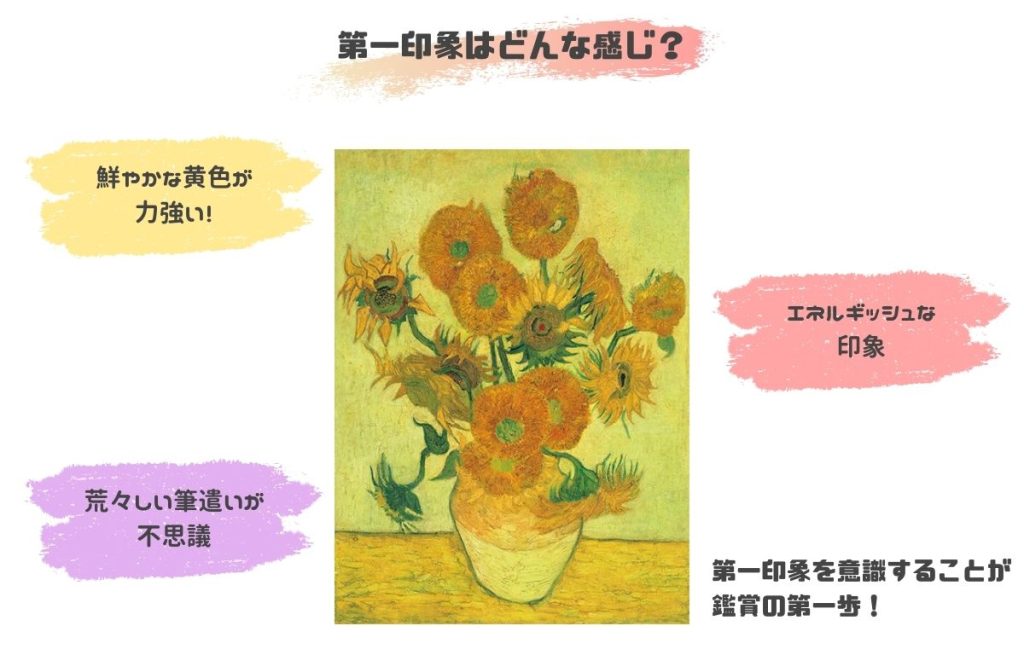
Being mindful of this first impression is the first step in appreciation. It can also be good to jot down what emotion you felt and the words that came to mind.
2. Observation and description: looking closely and putting it into words
Next, try to observe the painting before you in detail and put it into words.
- Color: The petals of the sunflowers and the background make abundant use of the vivid yellow characteristic of Van Gogh.
- Brushwork: The strong, rough touch stands out. There are thickly painted areas along the edges of the petals and on the stems, giving a sense of relief to the surface of the painting.
- Composition: The sunflowers arranged in the vase spread across the entire canvas, creating a sense of dynamism.
- Background: At first glance simple, yet the subtle movement of the brush keeps it from being monotonous, producing an effect of expanding space.
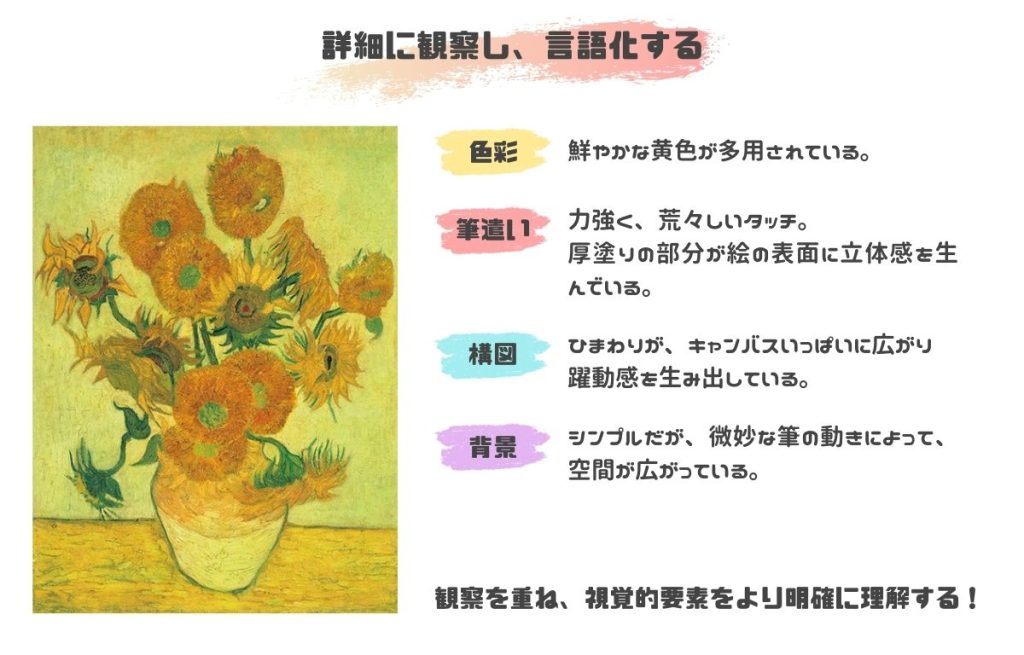
By observing in this way, you can more clearly grasp the visual elements the work possesses.
3. Analysis and synthesis: analyzing the composition and elements to understand the whole
Here, let's go a step further and analyze the work's constituent elements.
① The use of color
Van Gogh's "Sunflowers" is characterized by its abundant use of yellow. But it is not merely "bright yellow"—you notice that orange is mixed into the petals, and pale blues and greens are used in the background. This makes the yellow stand out all the more, giving rise to a contrast of color.
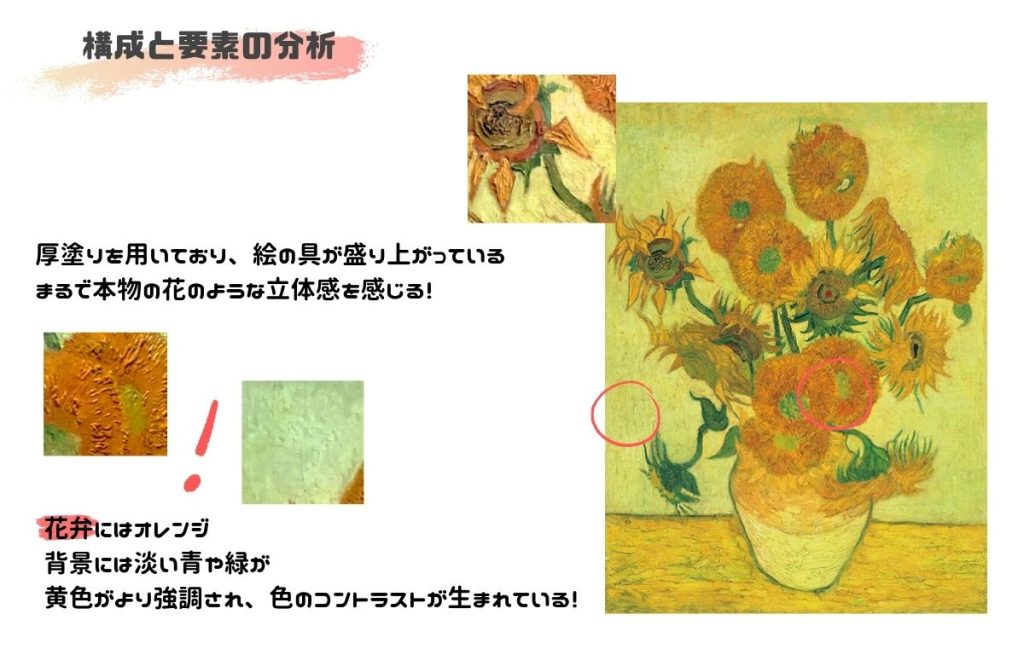
② The effect of the brushwork
Van Gogh used the technique of thick paint (impasto), and the paint builds up especially at the center of the flowers. This lets you feel a three-dimensionality—as if real flowers were there—even though it is a flat painting.
At this step, you can understand how the painting is visually composed and unravel the structure of the work.
4. Interpretation: reading the subject of a painting—considering its history and background
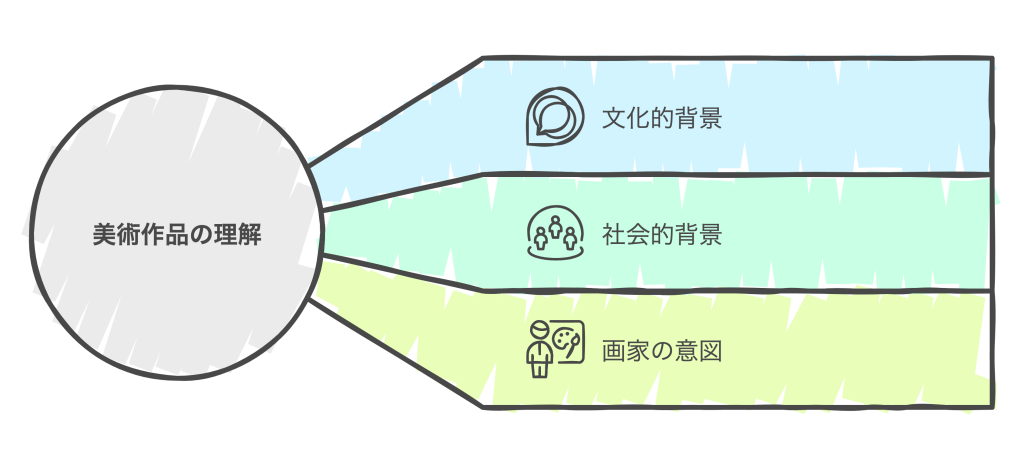
A work of art often reflects the culture and social background of its time. By considering the spirit of the age in which it was painted and the painter's intentions, you can understand it more deeply.
The painter's personal thoughts and outlook on life are also important points in interpreting a work.
① The background to the birth of "Sunflowers"
In 1888, Van Gogh moved to Arles in the south of France and produced several works with sunflowers as their motif. These are said to have been intended to decorate the "Yellow House" in welcome of his close friend Paul Gauguin.
For him, sunflowers were not merely flowers but a symbol of friendship, of hope, and of his own spirit.
② The symbolism of the sunflower
Because it grows reaching toward the light of the sun, the sunflower is regarded as a flower symbolizing "vitality" and "energy." But in Van Gogh's "Sunflowers," withering flowers are also depicted, so it can be interpreted as expressing not just a bright image but also the "cycle of life and death."
In this way, by exploring the period background of a work and the painter's intentions, a deeper appreciation becomes possible.
5. Evaluation: how do we assess a work's value?
Finally, we consider what kind of value the work holds.

① Its place in art history
"Sunflowers" is highly regarded as a masterpiece of Post-Impressionism, and in its originality of color and expressive power of brushwork it influenced the later Expressionism and Fauvism.
② Market value
Van Gogh's "Sunflowers" was sold in 1987 for around 5.3 billion yen (39.9 million dollars), the highest price of its time, and is held in extremely high regard in the art market as well.
And yet, its true value lies not in price alone but in its "artistic influence" and its "power to stir the emotions." Moreover, since the evaluation of a work changes with the times, it is important to consider it from a variety of perspectives.
Summary: what we gain through appreciation
What did you think? Appreciating a painting is not simply about looking at something beautiful—it is also about considering the meaning that lies behind it and deepening your own interpretation.
Taking Van Gogh's "Sunflowers" as our example, we have considered how to view and interpret a painting.
The key points of appreciation are as follows.
- Cherish your first impression and be conscious of your own emotions
- Observe the work closely and analyze its color, composition, and brushwork
- By learning the background and the painter's intentions, gain a deeper interpretation
Viewing a painting is not merely a "visual pleasure" but also an opportunity to feel history and ideas, and to converse with yourself. The next time you visit a museum, do try these steps and engage more deeply with the work. You may make new discoveries!
References
"The Textbook of Painting," Nihon Bunkyo Shuppan
In closing
We hope you enjoyed this article. If it has helped you feel a little closer to art, nothing would make us happier.
+ART, built around the concept of “enjoying art,” offers services that let you experience contemporary art more fully—from planning and running exhibitions to selling works through our online shop.
With a focus on talented emerging artists, we carefully curate works full of individual character! We carry a diverse range of art, from paintings and beyond, so that even first-time buyers can shop with confidence.
To help you appreciate each work more deeply, we also share useful information in our column—artist interviews, ways to display art, tips on buying, and more.
We hope it becomes an opportunity for art to blend into your daily life and color it more richly.
Why not add a little art to your space?
▶ +ART
▶ ONLINE SHOP