About the plus art Column
The plus art column delivers articles designed to make art feel closer to you. We introduce recommended artists for each season, offer clear explanations for those new to art, and share the appeal of art from many angles. Our aim is to help you discover hints for letting art settle naturally into everyday life. Please feel free to enjoy the world of art.
Contents
- Introduction: The Dawn of Civilization and the Birth of Art
- 1. The Sprouting of Civilization Seen in Painted Pottery
- 2. The Birth of Cities and Temples: The Beginnings of Sumerian Art
- 3. Worshipper Statues and the Stratification of Society
- 4. Artistic Development Seen in Exquisite Grave Goods
- 5. The Birth of Temple Architecture and Monuments
- 6. Gudea and the Establishment of Realistic Expression
- 7. Otherworldly Divine Beasts: The Five-Legged Monster Statues
- Conclusion: What Humanity’s Earliest Art Still Tells Us Today
Introduction: The Dawn of Civilization and the Birth of Art
When we hear the word “art,” what first comes to mind may be visually pleasing things such as paintings and sculptures. Yet the history of human art begins far earlier, together with the birth of civilization. Its very origin can be said to lie in the art nurtured by what is known as the “Mesopotamian civilization,” along the basins of the Tigris and Euphrates rivers. This time, we introduce the world of humanity’s oldest art, beginning with Mesopotamia.

1. The Sprouting of Civilization Seen in Painted Pottery
Around 6000 BCE, a primitive agricultural society already existed in Mesopotamia. People grew wheat, raised livestock, and lived in dwellings of sun-dried brick. And it was in this era that “painted pottery,” adorned with color and pattern, was born.
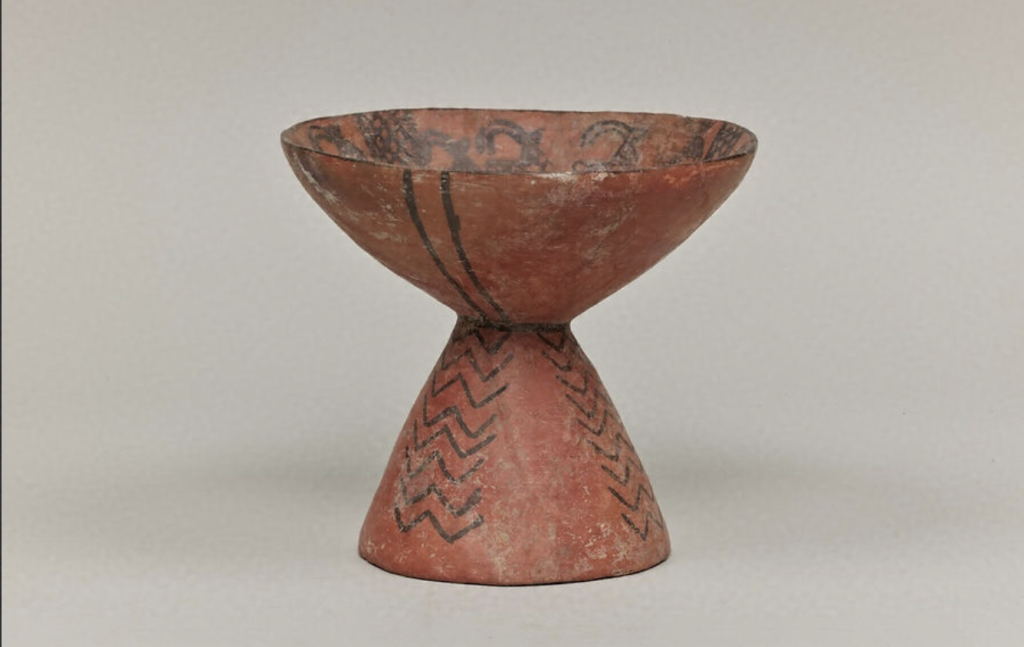
Especially from the Samarra period to the Halaf period (around 5100–4200 BCE), pottery was made bearing a wide variety of designs—lattice patterns, zigzags, checkerboards, and depictions of animals and human figures. These were not mere vessels but also evidence that speaks of cultural maturity and exchange with other cultures.
2. The Birth of Cities and Temples: The Beginnings of Sumerian Art
At the end of the 4th millennium BCE, settlements in Mesopotamia developed into cities, and an urban culture centered on temples took shape. It was the Sumerians who supported this.
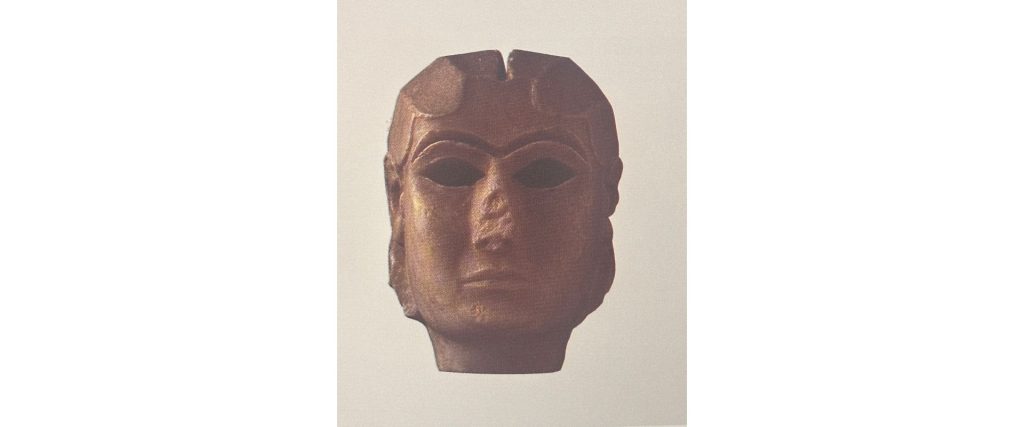
In the Uruk period (around 3500–3000 BCE), fired bricks and mosaic decoration applied to temples appeared, and many works of sculpture in the round were also produced. Among them, the “Head of a Woman” excavated at Uruk strongly conveys an ethnic identity through features such as its continuous eyebrows.
3. Worshipper Statues and the Stratification of Society
In the Jemdet Nasr period (from around 3000 BCE), numerous male and female worshipper statues were excavated. With shell inlays for the eyes and hands clasped before the chest, they show that religion and the social order were intertwined. Male figures with a band around the head and a cultivated beard symbolize the emergence of priests as religious leaders.
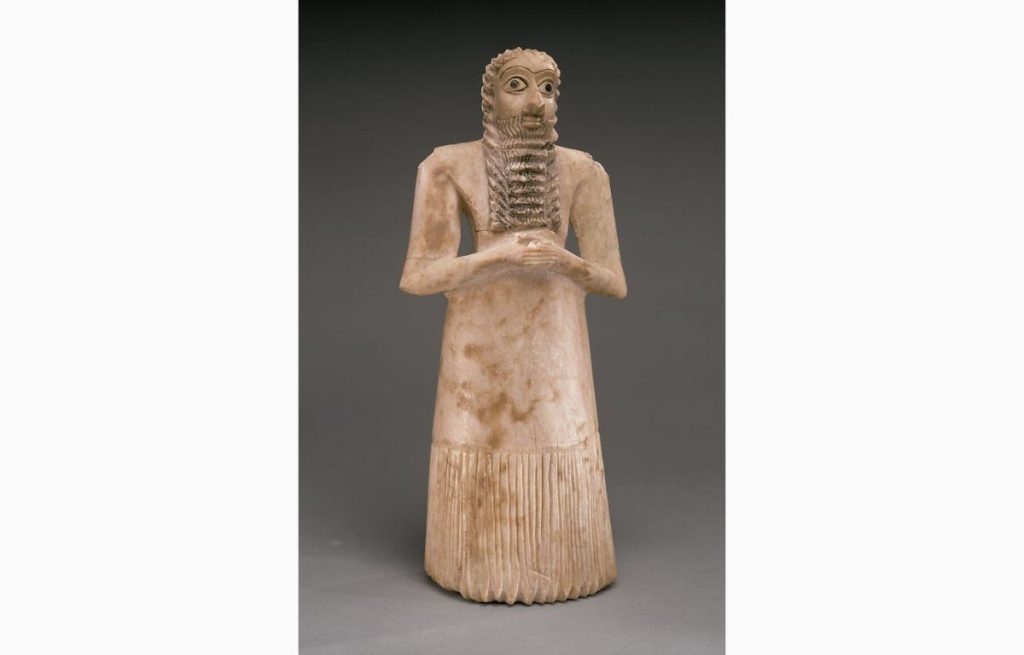
Entering the Early Dynastic period (around 2700–2350 BCE), this expression became more realistic, and the expressive power of sculpture advanced still further.
4. Artistic Development Seen in Exquisite Grave Goods
Grave goods excavated from the royal tombs, such as the “Ram in a Thicket” and the “Standard of Ur,” display extremely high craftsmanship using gold, silver, lapis lazuli, and shell. Their realistic modeling and symmetrical, balanced composition reveal the maturity of Sumerian art at the time.
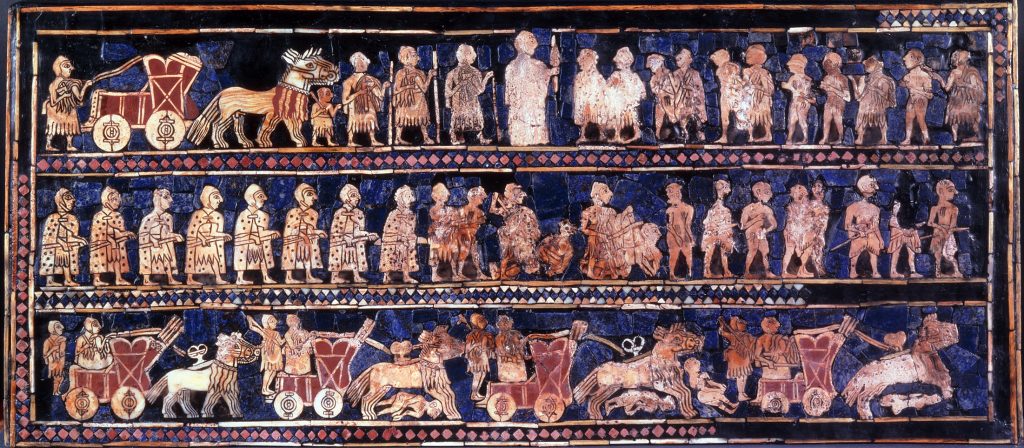
These works symbolize political power and the authority of the state, and also show that art, together with religion, was beginning to be used as a tool of state formation.
5. The Birth of Temple Architecture and Monuments
In the Third Dynasty of Ur (around 2130–2000 BCE), city building and temple architecture flourished. Massive ziggurats (stepped temples) and law steles carved with reliefs (such as the Stele of Ur-Nammu) appeared, and monumental works created through the fusion of architecture and sculpture were produced.
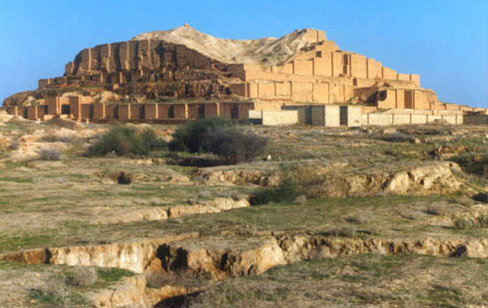
In this era, an “art as record” and an “art that supports the order of society”—going beyond mere aesthetic decoration—took shape.
6. Gudea and the Establishment of Realistic Expression
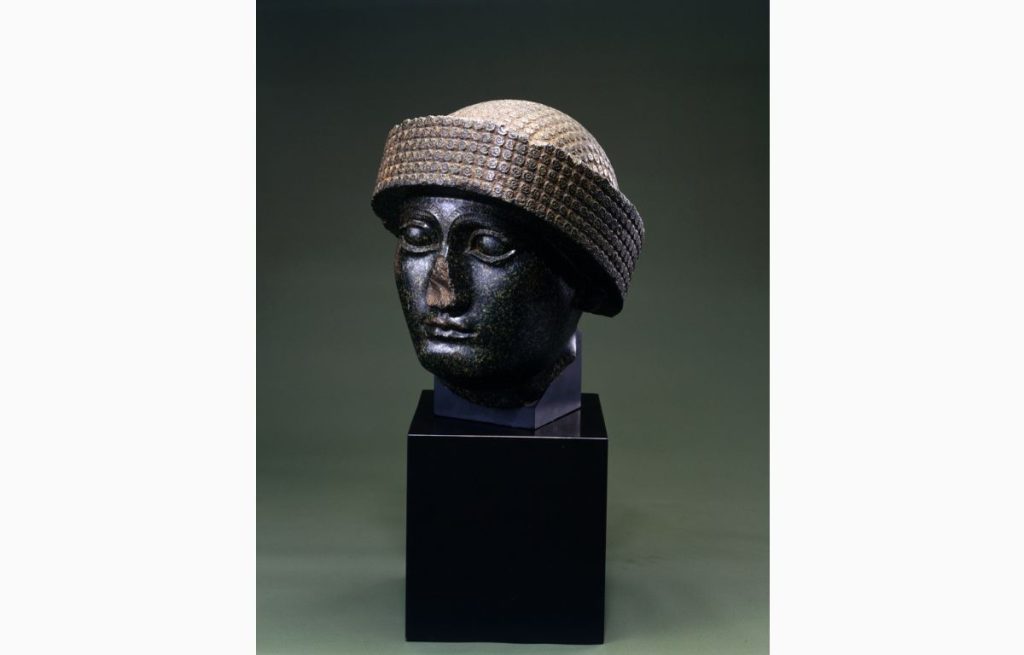
Gudea, the ruler who broke away from the Third Dynasty of Ur and held power in Lagash, dedicated seated statues of himself along with numerous temples. Made of hard diorite, the statues of Gudea possess natural fleshiness and a sense of structure, and can be regarded as the high point of realistic expression in Sumerian art.
7. Otherworldly Divine Beasts: The Five-Legged Monster Statues
The “five-legged monster statues” placed at city gates were crafted with a visual trick in which the number of legs appears to change when viewed from the front versus the side, and were set there to ward off evil spirits and misfortune. These are not mere sculpted forms but can be called a symbol of ancient Near Eastern art, drawing on “the wonder of form as sacredness.”

Conclusion: What Humanity’s Earliest Art Still Tells Us Today
Mesopotamian art can be called humanity’s first total art, in which religion, society, technology, and expression are all intertwined. The faith embodied in pottery patterns and worshipper statues, the architectural art that developed alongside city building, and the monuments that symbolize royal authority and order—all of these are the very root of the emotion we feel toward “art” today. Knowing the art of the past becomes the foundation for savoring contemporary art more deeply. Please take this chance to encounter ancient beauty for yourself!
In Closing
How did you find it? We hope this article has helped you come to know art a little more deeply.
Under the concept of “enjoying art,” plus art offers services that let you enjoy contemporary art even more—from planning and running exhibitions to selling works through our online shop.
Focusing on gifted young artists, we carefully select and introduce works full of individuality! With a diverse lineup of paintings and other art, we make it easy and reassuring even for first-time art buyers.
To help you appreciate the appeal of each work more deeply, we also share useful information in our column, including artist interviews, tips on displaying art, and pointers for buying.
We hope art becomes part of your daily life and a chance to enrich your world with color.
Why not add a little art to your space?
▶ plus art
▶ ONLINE SHOP